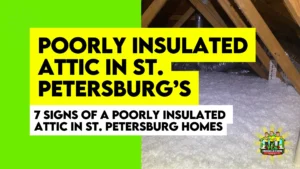



In St. Petersburg homes, a poorly insulated attic is one of the most common and overlooked causes of high cooling bills, uneven indoor temperatures, and constant air-conditioning strain.
According to U.S. housing data, a large share of homes in Saint Petersburg and Pinellas County were built before the early 1990s, when modern attic insulation standards and R-value requirements became more widely adopted in Florida.
In a humid, coastal Florida climate including St. Pete, this older insulation is exposed to long cooling seasons, moisture-rich air, and prolonged attic heat buildup, which causes insulation to compress, settle, and lose thermal resistance over time.
These conditions are common not only in St. Pete but also across nearby coastal Florida communities, where attic performance plays a critical role in energy efficiency, indoor comfort, and humidity control.
7 Signs of a Poorly Insulated Attic in St. Petersburg Homes
| Sign Homeowners Notice | What It Usually Indicates | Why It’s Common in St. Petersburg |
|---|---|---|
| Upstairs rooms feel hotter in the afternoon | Excess attic heat transferring into living space | Long cooling seasons and older attic insulation levels |
| AC runs longer than usual | Increased heat load from the attic | Heavy reliance on air conditioning in Pinellas County homes |
| Higher summer electric bills | Ongoing heat gain through the ceiling | Cooling costs dominate energy use in coastal Florida |
| Uneven temperatures between rooms | Inconsistent or settled insulation coverage | Many homes built before modern insulation standards |
| Warm ceilings or heat from above | Weak thermal barrier in the attic | Low-slope roofs common in St. Pete housing |
| Musty or damp indoor smells | Moisture trapped in attic insulation | High coastal humidity and limited attic airflow |
Upstairs Rooms Feel Hotter in the Afternoon
- Severity: Medium → High (progressive issue)
- Solution Nature: Repairable in early stages, replacement if long-term
In many St. Petersburg homes, afternoon heat buildup is caused by insufficient attic insulation allowing roof heat to transfer directly into living spaces. This is especially common in older homes with low insulation depth, where prolonged sun exposure on low-slope roofs increases attic temperatures during peak hours.
Air Conditioner Runs Longer Than Usual
- Severity: High (direct energy and system impact)
- Solution Nature: Usually repairable, sometimes combined with upgrades
In Pinellas County including Saint Petersburg, homes rely on air conditioning for most of the year, and a poorly insulated attic increases heat load on the system. When insulation no longer provides proper thermal resistance, AC units in St. Pete homes must run longer to maintain indoor temperatures, accelerating wear and energy use.
Pro Tip: When several of these signs appear together, working with a professional insulation company in St. Petersburg can help determine whether attic insulation can be improved or needs replacement
Higher Summer Electric Bills
- Severity: Medium → High (cost-related indicator)
- Solution Nature: Repairable or replacement depending on insulation age
Rising summer utility bills in coastal Florida homes often point to continuous heat gain through the ceiling. In St. Petersburg, where cooling costs dominate energy use, outdated or compressed attic insulation allows warm air to penetrate the home throughout the day.
Uneven Temperatures Between Rooms
- Severity: Medium (comfort-related but widespread)
- Solution Nature: Repairable if caused by insulation gaps
Many older St. Pete homes built before the 1990s have insulation that has settled unevenly over time. This creates inconsistent thermal coverage, causing some rooms to stay warmer than others, especially in homes with shallow attic spaces and mixed renovation histories.
Warm Ceilings or Heat Radiating From Above
- Severity: High (clear insulation failure indicator)
- Solution Nature: Replacement or major upgrade recommended
When ceilings feel warm to the touch, it usually means the attic lacks an effective thermal barrier. This issue is common in St. Petersburg homes with low-slope roofs, where heat accumulates quickly and radiates downward when insulation depth is insufficient.
Musty or Damp Smells Inside the Home
- Severity: High (moisture-related risk)
- Solution Nature: Replacement often required if insulation is compromised
In St. Pete or humid coastal Florida climates, moisture can become trapped in attic insulation, especially when ventilation and insulation performance are poor. In St. Pete homes, this often leads to damp insulation and musty odors that move into living spaces, signaling reduced insulation effectiveness.
Practical Solutions for a Poorly Insulated Attic in St. Petersburg Homes
Addressing a poorly insulated attic in St. Petersburg homes depends largely on the condition of existing attic insulation, moisture exposure, and thermal performance loss over time. In a humid, coastal Florida climate, solutions focus on restoring an effective thermal barrier while controlling heat transfer and humidity intrusion.
Improving Insulation Coverage
- Suitable when insulation is settled, compressed, or uneven
- In many older St. Pete homes, insulation depth no longer provides adequate thermal resistance (R-value), allowing excessive attic heat gain through the ceiling plane.
Removing Damaged or Moisture-Affected Insulation
- Necessary when insulation has suffered moisture intrusion or performance degradation
- Prolonged exposure to high coastal humidity in Pinellas County can cause insulation to lose effectiveness, making insulation removal and replacement more appropriate than layering new material.
Sealing Air Leaks in the Attic
- Often paired with insulation upgrades for better results
- Air leakage points around penetrations and framing allow hot, humid air to enter the home, increasing cooling load during St. Petersburg’s extended summer season.
Using Climate-Appropriate Insulation Materials
- Important for long-term performance in coastal Florida homes
- Materials selected for humid environments help maintain thermal resistance, reduce condensation risk, and support consistent energy efficiency over time.
In many situations, working with a professional insulation company in St. Petersburg, FL helps homeowners identify which combination of solutions best fits their attic’s condition, home age, and exposure to local climate conditions.
Why Humidity and Coastal Conditions Cause Attic Insulation to Fail in St. Petersburg
Attic insulation in St. Petersburg homes faces challenges that are far more aggressive than in inland or northern climates. The combination of persistent humidity, long cooling seasons, and coastal air exposure directly impacts how insulation performs over time.
Key environmental factors affecting St. Pete attics
- High outdoor humidity for most of the year increases moisture movement into attic spaces
- Extended AC use creates strong temperature differences between living areas and the attic
- Coastal air exposure accelerates insulation aging, especially in older roof assemblies
These conditions are common across Pinellas County, particularly in neighborhoods with older construction and shallow attic designs.
How moisture reduces insulation performance
- Moisture migration allows humid air to enter insulation layers
- Insulation becomes compressed or damp, reducing effective thermal resistance (R-value)
- Condensation risk increases when warm attic air meets cooler surfaces
Once insulation absorbs moisture, it no longer functions as a reliable thermal barrier, allowing more heat transfer into the home.
Why older St. Petersburg homes are more vulnerable
- Many homes were built before the early 1990s, prior to updated Florida Building Code insulation standards
- Original attic insulation materials were not designed for prolonged coastal humidity
- Low-slope roofs and shallow attic spaces, common in St. Pete housing, trap heat more easily
Because these issues develop gradually, insulation failure in coastal Florida homes often goes unnoticed until cooling efficiency, comfort, or indoor air quality noticeably declines.
Where Attic Insulation Issues Commonly Appear in Saint Petersburg and Across Pinellas County
| Area / City | Why Attic Insulation Problems Are Common | Typical Housing & Climate Factors |
|---|---|---|
| St. Petersburg | Many homes show signs of attic heat gain and moisture-related insulation decline due to age and coastal exposure. | Large number of pre-1990 homes, low-slope roofs, proximity to the Gulf, and long cooling seasons. |
| Clearwater | Attic insulation often underperforms during peak summer months, leading to higher cooling demand. | Similar construction timelines to St. Pete, heavy AC reliance, and high year-round humidity. |
| Largo | Uneven indoor temperatures are common due to settled or inconsistent attic insulation. | Mid-century housing stock with older insulation materials and shallow attic spaces. |
| Pinellas Park | Homes frequently experience insulation gaps and air leakage that increase attic heat transfer. | Dense residential layouts, limited attic ventilation, and older roof assemblies. |
| Seminole | Attic insulation often no longer meets current performance expectations for Florida’s climate. | Predominantly older single-family homes built before updated Florida insulation standards. |
| Gulfport | Coastal exposure accelerates insulation degradation and moisture intrusion in attic spaces. | Close proximity to the coast, salt-laden air, and older construction methods. |
How Professional Insulation Contractors Address Attic Issues in St. Petersburg Homes
- Attic access and condition review: Inspection of attic insulation condition, checking for settling, compression, and moisture exposure common in older St. Petersburg homes.
- Insulation depth and performance evaluation: Measuring existing insulation depth against climate-appropriate expectations for humid coastal Florida, where insufficient R-value directly increases heat transfer.
- Moisture and humidity assessment: Identifying signs of moisture intrusion, condensation risk, and damp insulation, especially in homes affected by coastal air exposure.
- Air leakage and heat gain analysis: Locating air leakage points that allow hot, humid attic air to enter living spaces, increasing cooling load during long St. Pete summers.
- Condition-based solution planning: Determining whether insulation is repairable, upgrade-ready, or requires removal and replacement based on age, damage, and performance loss.
- Climate-specific recommendations: Selecting moisture-resistant insulation solutions designed to maintain thermal resistance and durability in Pinellas County’s coastal climate.
Why St. Petersburg Homeowners Work Choose TLS Energy Savers
As a professional insulation company in St. Petersburg, we understand the attic challenges caused by local housing styles, high humidity, and coastal conditions. Our approach focuses on accurate evaluations and long-term performance, not generic fixes or one-size-fits-all solutions.
Frequently Asked Questions (FAQs)
Why do many St. Petersburg homes struggle with attic insulation issues?
A large portion of homes in St. Petersburg were built before the early 1990s, when attic insulation standards were lower. Combined with long cooling seasons and coastal humidity, older insulation in these homes often underperforms.
Is attic insulation failure more common near the coast in St. Pete?
Yes. Homes closer to the Gulf are exposed to higher moisture levels and salt-laden air, which can accelerate insulation degradation and reduce thermal performance over time.
Do low-slope roofs in St. Petersburg affect attic insulation performance?
They do. Low-slope roofs, common in many St. Pete neighborhoods, trap heat more easily and leave less attic space for insulation, making proper insulation depth especially important.
Why do cooling bills rise so quickly in St. Petersburg homes with poor insulation?
In Pinellas County, air conditioning runs for much of the year. When attic insulation is insufficient, heat gain through the ceiling increases, forcing AC systems to work longer during extended summer months.
When should St. Petersburg homeowners consider an attic insulation inspection?
If your home feels warmer upstairs, your AC runs constantly, or summer electric bills keep rising, it’s often a sign that attic insulation performance no longer matches St. Pete’s climate demands.