
Pinellas County Top-Rated Insulation Contractor
Serving every Lee County community — from Fort Myers’ historic downtown to Cape Coral’s 400+ canal miles, Lehigh Acres’ subdivisions, the post-Ian reconstruction zones of Fort Myers Beach & Sanibel, and Estero’s retirement neighborhoods. IECC Climate Zone 1A — the hottest classification in the continental US.
As an FPL Participating Independent Contractor, TLS handles the $220 ceiling insulation rebate for the FPL-served majority of Lee County. We also offer free moisture meter assessments for any home affected by Hurricane Ian’s September 2022 direct landfall.
GET A FREE COST ESTIMATION
Lee County is classified as IECC Climate Zone 1A — the hottest residential climate zone in the continental United States. This sits Lee County alongside only a handful of US counties (including neighboring Charlotte) and creates implications for insulation that virtually no contractor explains clearly.
The Florida Building Code minimum for Zone 1A is R-30 — but that's the legal floor for permit compliance, not the performance target. The FPL $220 rebate threshold is R-38, and TLS recommends R-49 as the optimal target. The incremental cost from R-38 to R-49 is typically only $150–$300 in additional material on a 1,500 sqft attic.
The practical reality: a Lee County home upgraded only to R-30 reaches 27% of TLS's recommended R-49 target. Bringing the same home to R-49 delivers dramatically more cooling cost reduction — and qualifies for the full FPL incentive stack.
| County | IECC Zone | FBC Min | TLS Target |
|---|---|---|---|
| Lee | 1A | R-30 | R-49 |
| Charlotte | 1A | R-30 | R-49 |
| Hillsborough | 2A | R-38 | R-49 |
| Sarasota | 2A | R-38 | R-49 |
| Manatee | 2A | R-38 | R-49 |

"Lee County's Zone 1A designation throws people off. They hear 'lower code minimum' and assume that means less insulation is OK. The reality is the opposite — Zone 1A means the hottest cooling load in the country. R-30 might be code, but it's the wrong target for a 92°F July in Fort Myers. R-49 is what we install, and the math on FPL bills bears it out within the first cooling cycle."
Seth Hoerig Owner, TLS Energy SaversIan made direct landfall at Fort Myers Beach and Sanibel on September 28, 2022 — the deadliest Florida hurricane since 1935 and the most destructive natural disaster in Lee County history. Three years later, the insulation implications still dominate this market.
Hurricane Ian's catastrophic storm surge and Category 4 winds reshaped Lee County's housing stock. Fort Myers Beach and Sanibel experienced near-total destruction; Cape Coral waterfront and Pine Island took severe surge damage; Lehigh Acres and inland Lee County suffered significant wind impact with attic penetrations and moisture intrusion.
Thousands of Lee County homeowners replaced their roofs in the 2022–2024 window after Ian. But new roofing alone doesn't fix attic moisture damage — it just covers it.
As of 2026, many homes that experienced storm surge, roof penetration, standing water in the attic, or extended moisture exposure before roof replacement may be operating with degraded, moisture-contaminated insulation beneath new shingles — without the homeowner ever knowing.
If you replaced your Lee County roof in 2022, 2023, or 2024 after Ian damage, the new roof is on top of insulation that may have been compromised during the storm. Wet insulation:
The diagnostic test: if your monthly FPL or LCEC bills haven't returned to pre-Ian levels and the AC seems to be running longer cycles than before, your attic insulation is the most likely culprit. A free TLS moisture meter assessment confirms whether existing insulation can be retained or must be removed.
| Clean insulation Dry, no contamination, HEPA vacuum & bagging | $1.00–$1.50 / sqft |
| Moisture-damaged Ian storm surge area, antimicrobial treatment | $1.50–$3.00 / sqft |
| Mold-present Remediation protocol, full documentation | $2.00–$3.50 / sqft |
| Post-storm with pest intrusion Biohazard, sanitization required | $2.00–$4.00 / sqft |
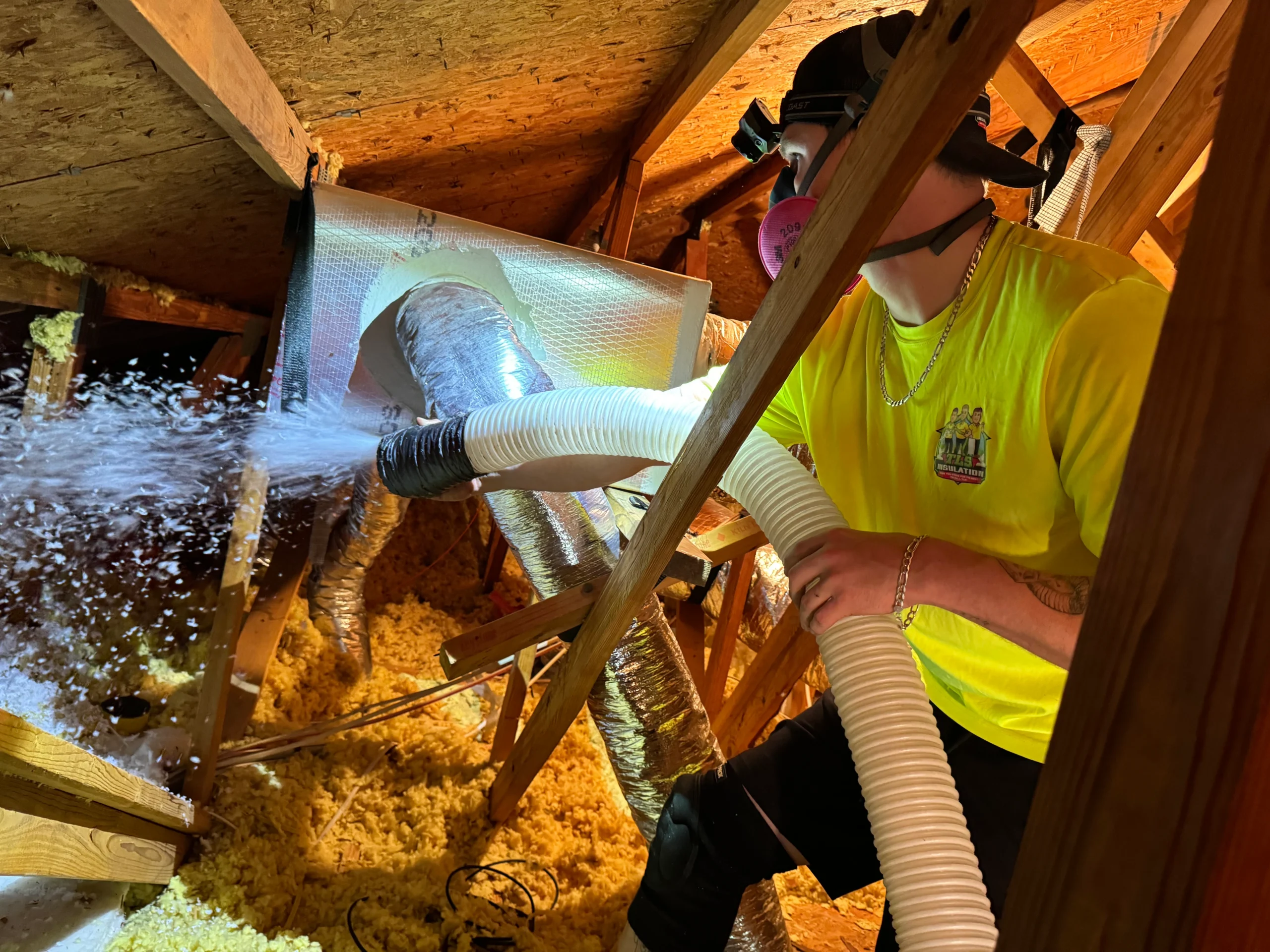
TLS reads moisture content at 8–10 attic points to determine whether your existing Ian-era insulation can be retained (top-off) or must be removed (contaminated removal) before new installation. Free of charge for any Lee County home.
Cape Coral is one of the largest cities in Florida by area, with over 400 miles of navigable canals running through virtually every neighborhood. The canal system creates an ambient moisture environment throughout the city that exceeds typical inland Lee County conditions — and the resulting insulation specifications are calibrated accordingly.
For most Cape Coral homes, standard blown-in fiberglass is appropriate for the attic floor. For homes in FEMA AE flood zones (significant portions of Cape Coral), closed-cell spray foam may be evaluated for under-floor and roof deck applications where moisture is a structural concern. CBS construction is dominant in Cape Coral — wall cavity injection with appropriate materials is a secondary service offering.
Most Cape Coral homes were built between the 1970s and 1990s with original R-11 to R-19 insulation — making them ideal FPL rebate candidates. Note: most of Cape Coral is FPL territory; the western portions are LCEC. Check your utility bill to confirm which rebate program applies to your specific address.
Cape Coral Insulation Service Page →Unlike Charlotte County (100% FPL) or Sarasota County (100% FPL), Lee County is split between two electric utilities. Knowing which one serves your address determines whether the $220 ceiling insulation rebate applies — TLS confirms this at the free inspection.
How to know which utility you're on: check the top of your monthly electric bill. If it says "FPL" or "Florida Power & Light," you qualify for the $220 rebate. If it says "LCEC" or "Lee County Electric Cooperative," the FPL rebate doesn't apply — but TLS still offers Wisetack financing with monthly payment options to make the upgrade accessible. Either way, every Lee County installation gets the same Johns Manville material standard and the same certified crew.
What We Do
Every service performed by TLS’s in-house, certified team — no subcontractors. Lee County’s combination of Zone 1A heat, Hurricane Ian aftermath, and Cape Coral’s canal moisture environment requires specific service approaches refined over 11+ years in this market.
Pricing in Lee County varies by attic size, current insulation condition, and whether removal is required. Hurricane Ian-era removals typically push costs into the moisture-damaged or mold-present categories — which is why the free moisture assessment matters before any quote.
For a typical 1,500 sqft Fort Myers attic upgraded from R-11 to R-49: ~$2,000 gross cost. After the FPL $220 rebate applied directly to your invoice, net homeowner cost drops to ~$1,780 in FPL territory. LCEC territory homes (Estero, Sanibel, Captiva, Bonita Springs) pay the full ~$2,000 — but qualify for Wisetack monthly financing to spread the cost.
| Service | Per Sq Ft | 1,500 sqft |
|---|---|---|
| Blown-in fiberglass install Johns Manville · Lifetime Warranty | $1.00–$2.20 | $1,500–$3,300 |
| Removal — clean Dry, no contamination | $1.00–$1.50 | $1,500–$2,250 |
| Removal — Ian moisture-damaged Antimicrobial treatment included | $1.50–$3.00 | $2,250–$4,500 |
| Removal — mold present Full remediation protocol | $2.00–$3.50 | $3,000–$5,250 |
| FPL rebate FPL territory only · applied to invoice | — | – $220 |
TLS Energy Savers is a family-owned residential insulation company and a certified FPL Participating Independent Contractor serving the FPL-territory majority of Lee County. With 11+ years in this market and 50,000+ homes served, our team has been in Lee County attics through the entire Hurricane Ian recovery cycle.
What sets us apart in Lee specifically: Johns Manville Lifetime Warranty on every blown-in fiberglass install (the only insulation warranty of its kind in this market), 6-county service authority from Hillsborough down to Lee, accurate Zone 1A technical guidance, and free Hurricane Ian moisture assessments. No subcontractors. No surprises.
✔ Duke Energy Florida pre-approved contractor — limited network
✔ Johns Manville Lifetime Warranty — only material suited for Lee County
✔ No subcontractors — the team that quotes you performs the install
✔ BPI / NATE certified technicians — Duke’s required certification bodies
50,000+
home insulated
11 Years+
In Business
14
Pinellas Cities
From Fort Myers' historic downtown to Cape Coral's 400+ canal miles, Lehigh Acres' sprawling subdivisions, the post-Ian reconstruction zones of Fort Myers Beach and Sanibel, the LCEC retirement communities of Estero and Bonita Springs, and Pine Island's St. James City — TLS serves every Lee County address. The pills below are color-coded by utility (FPL or LCEC) so you can quickly identify your rebate eligibility.
Lee County's primary urban market. Historic downtown River District (1950s–1980s, often R-7 to R-11 original) plus suburban east (Gateway, San Carlos Park) with 1990s–2000s housing. TLS's highest-volume Lee sub-region.
Cape Coral is one of Florida's largest cities by area with 400+ miles of canals — most served by FPL, western portions by LCEC. CBS construction dominant. Pine Island (St. James City) is LCEC. Check your bill to confirm utility.
Highest density of under-insulated homes in Lee County — Lehigh Acres' sprawling 1960s–1990s subdivisions plus Alva's rural eastern communities. Original R-7 to R-13 stock makes these prime FPL rebate territory.
Direct landfall area for Hurricane Ian (Sept 2022). Fort Myers Beach (FPL, near-total destruction), Sanibel/Captiva (LCEC), and Boca Grande (LCEC). Active reconstruction market — premium barrier island specifications apply throughout.
South Lee County retirement-community market — Estero's master-planned communities and Bonita Springs at the Lee/Collier border. Newer 1990s–2010s housing stock (often R-19 to R-30 original). LCEC territory homes don't qualify for the FPL $220 rebate, but Wisetack monthly financing spreads the cost — and the upgrade ROI in Zone 1A's 9-month cooling season remains strong.
Not in Lee County? TLS also serves neighboring counties across Southwest Florida — same crew, same Johns Manville material standard, same Lifetime Warranty.
These verified reviews reflect what matters most to homeowners choosing an insulation company. Our dependable installers, clean workmanship, responsive support, honest pricing, and finished results has earned a stellar reputation across Southwest Florida.
Common questions from Lee County homeowners about insulation, R-values, FPL rebates, Hurricane Ian assessments, and pricing — answered directly by our team.
Lee County is in IECC Climate Zone 1A. The Florida Building Code minimum is R-30 — but the FPL $220 rebate threshold is R-38, and TLS recommends R-49 as the optimal target.
The incremental cost from R-38 to R-49 is typically only $150–$300 in additional material on a 1,500 sqft attic — and in Lee County's 9-month cooling season, that delta produces compounding annual savings. The payback period on R-38 vs R-49 is typically 6–18 months in Zone 1A.
Lee County is IECC Climate Zone 1A — the hottest classification in the continental United States. This is the same as neighboring Charlotte County, but distinct from Hillsborough, Pinellas, Sarasota, and Manatee, which are all Zone 2A.
Zone 1A's FBC code minimum is R-30 (lower than Zone 2A's R-38) — but the right insulation target (R-49) is the same regardless of zone given Florida's cooling load.
Yes. Most of Lee County is FPL territory — including Fort Myers, Fort Myers Beach, North Fort Myers, Lehigh Acres, Alva, Gateway, San Carlos Park, Iona, and most of Cape Coral.
FPL offers a $220 flat ceiling insulation rebate, and TLS is an FPL Participating Independent Contractor — we apply the rebate directly to your invoice. Estero, Bonita Springs, Sanibel, Captiva, Boca Grande, and the western portions of Cape Coral are LCEC territory and don't have an insulation-specific rebate, but TLS offers Wisetack monthly financing for these homes.
Schedule a free TLS moisture meter assessment. Hurricane Ian made direct landfall at Fort Myers Beach and Sanibel on September 28, 2022.
Many Lee County homes received new roofs in the 2022–2024 window — but new roofing doesn't fix attic moisture damage; it just covers it. TLS reads moisture content at 8–10 attic points to determine whether existing insulation can be retained (top-off) or must be removed (contaminated removal) before new installation. Free of charge regardless of utility territory.
For Cape Coral's CBS canal homes, TLS specifies blown-in fiberglass for the attic floor as standard — moisture-resistant, Lifetime Warranty backed.
Closed-cell spray foam may be evaluated for homes in FEMA AE flood zones (significant portions of Cape Coral) where moisture migration through the assembly is a structural concern. CBS wall cavity injection is the secondary upgrade option for whole-home efficiency improvement given the 400+ miles of canal-driven ambient moisture.
For a typical 1,500 sqft Fort Myers attic upgraded from R-11 to R-49: gross project cost is approximately $2,000. After the FPL $220 rebate (FPL territory only) applied directly to your invoice, net homeowner cost is approximately $1,780 in FPL territory.
LCEC territory homes (Estero, Sanibel, Captiva, Bonita Springs) pay the full $2,000 — but qualify for Wisetack monthly financing to spread the cost. Estimated monthly cooling savings: ~$45/month. Payback period: ~40 months.
Yes. TLS provides free moisture meter assessments for any Lee County home that experienced Hurricane Ian damage — regardless of whether you're on FPL or LCEC.
We measure moisture content at 8–10 attic points, identify compression and contamination levels, and confirm whether replacement is needed. Call (833) 857-7283 to schedule. The assessment is genuinely free with no obligation to use TLS for the subsequent installation.
TLS serves all Lee County communities: Fort Myers, Cape Coral, Lehigh Acres, Estero, North Fort Myers, Alva, Iona, Fort Myers Beach, Sanibel Island, Captiva Island, Gateway, San Carlos Park, Boca Grande, St. James City, and Bonita Springs.
The same TLS crew and Johns Manville material standard apply regardless of which community you're in — the only thing that changes by location is which utility (FPL or LCEC) serves your address and therefore which rebate or financing option applies.
Talk to a TLS specialist directly — free quote, free moisture assessment, no obligation.